Carnival Room
Fire Eater
This is a fan-made archive, not affiliated with Diane Paulus, Randy Weiner, or the official Phantom of the Opera production at 218 W. 57th. By entering, you acknowledge that.
Everything documented here is drawn from primary sources — published interviews with the production team, on-the-record reviews, press materials, and observable production detail. Information may still be inaccurate. Corrections are welcome.
Six audience groups. Sixty people each. One former art-supply store on 57th Street. Twenty-eight live actors wired up and wandering the building. More than a thousand hidden speakers. One 800-pound chandelier with its own automation system. And a piece of custom software running thirty-something clocks at once to keep the whole thing from falling apart. This is all of the public information currently available on how Masquerade works.
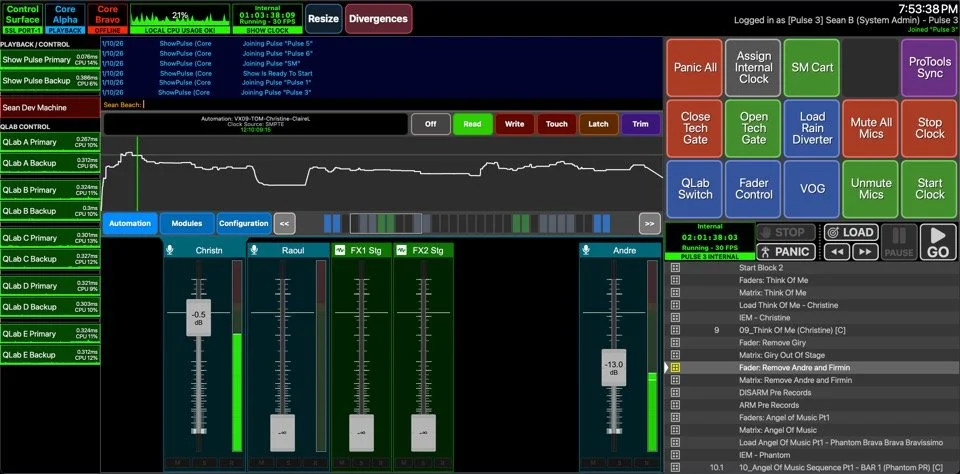
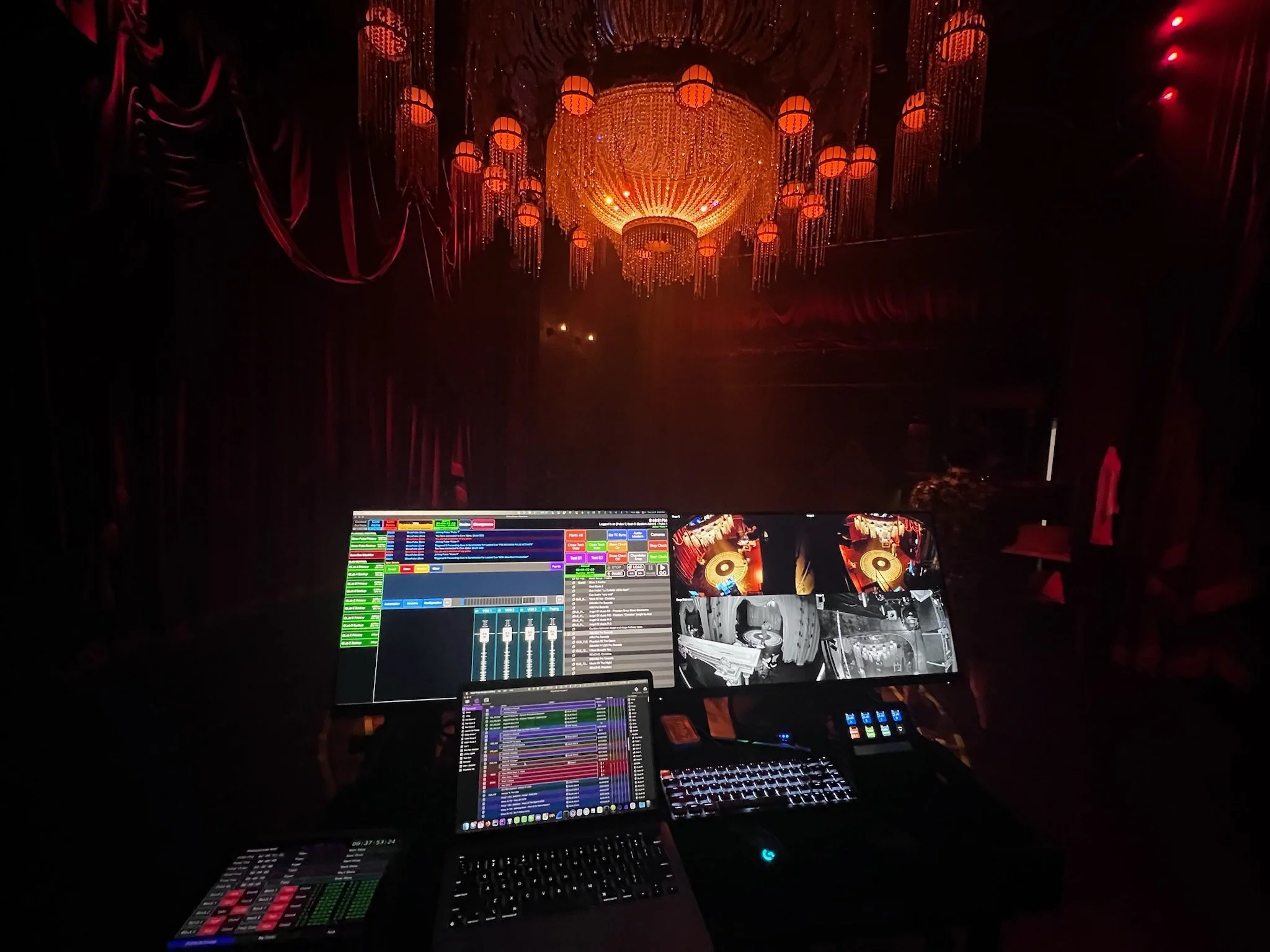
Traditional Broadway shows run on a stage manager calling cues into a headset while a conductor leads the orchestra and a mixer rides faders at the back of the house. Masquerade has none of that — no conductor, no live mixer, no central audience. The brain is a piece of custom software called ShowPulse, built by sound designer Brett Jarvis and programmer Sean Beach, running on redundant Mac Minis tucked into a rack room and talking to every other system in the building.
the playback
The pre-recorded music and sound effects live in QLab, running on Mac Minis throughout the building. ShowPulse tells QLab when to play what for which audience group, and dynamically swaps the right voiceover for whichever actor is playing that role tonight.
PAS · Precision Audio Services, Jan 2026
An 1897 landmark — once the headquarters of the American Society of Civil Engineers, then a Schrafft's, then Lee's Art Shop until 2016. A cellar, a ground floor, three retail floors above it, and a rooftop that doubles as outdoor performance space when the weather cooperates — that's where 'All I Ask of You' plays, with a fully-dressed indoor backup room on the 4th Floor for nights it doesn't. Not a single overhead rigging point in the whole building: PRG built freestanding truss where it could carry the load, and the rest of the fixtures went into plaster ceilings, unistrut runs, cornice molding, and the chandelier itself. Ben Stanton's team lit thirty distinct spaces inside. All six pulses follow the same canonical path through them, staggered fifteen minutes apart, never doubling up in the same room.
When any actor opens their mouth, their voice takes an eleven-step journey before it reaches your ear — earset microphone, bidirectional bodypack, digital antenna, Spectera base station, Dante network, Yamaha Rivage DSP, Biamp Tesira matrix, back onto the network, LD Systems amplifier, speaker. Walk it node by node.
the human
The voice starts here. Twenty-eight live miced actors are in the show, each one playing one specific role for one specific pulse on the canonical 15-minute stagger.
SOURCEPAS · Lee McCutcheon via Precision Audio Services, Jan 2026
tiny capsule, on the ear
A flesh-tone earset microphone with the capsule curving toward the corner of the actor's mouth, cable taped down their costume to the bodypack. Specific model not publicly disclosed.
SOURCEPAS · Precision Audio Services
mic out + IEM in, one unit
Sennheiser SEK bidirectional bodypack — does two jobs in one device: transmits the actor's voice AND receives the in-ear monitor mix. This bidirectional design is what makes Spectera new.
SPEC1 unit · WMAS modulation · UHF + 1G4 carriers
SOURCESenn2 · Sennheiser Spectera product literature
bidirectional digital antenna
Sennheiser DAD bidirectional digital antennas are distributed around the building so wherever an actor walks, an antenna is in range. Connects back to the base station over a single Cat6 cable carrying both directions of RF.
SOURCESenn2 · Sennheiser
64 ch each · 3 boxes total
Three Spectera base stations handle the entire show. Each is 1RU and supports up to 64 channels (32 in / 32 out). Uses a brand-new technology called WMAS — Sennheiser's first WMAS-based digital wireless ecosystem, unveiled at IBC in September 2024. Cameron Stuckey, the show's RF engineer, later took the same technology to Super Bowl LX.
SPEC3 × 1RU · 64 ch each · WMAS
SOURCEPAS · PRG · Sennheiser · AudioXpress
audio over Ethernet
Dante is the industry-standard way to send hundreds of audio channels over normal Ethernet cables and switches. Once a signal is on Dante, anything on the same network can grab it.
SOURCEAH · Adam Hall Group; PAS · Precision Audio Services
the mix, but no board
A high-end Yamaha digital mixing system — without a physical mixing surface in front of the show. The DSP engine is in a rack room. ShowPulse drives it over OSC, playing back fader moves, EQ, and dynamics programmed during tech rehearsals on a Solid State Logic UF8 controller. There is no live mixer during a performance.
SPECsubmodel undisclosed · OSC-driven · SSL UF8 (tech-only surface)
SOURCEPAS · Precision Audio Services
routing matrix
Multiple Biamp Tesira Server DSPs work together as one giant routing matrix. They decide which microphones go to which speakers in which rooms at which moment. ShowPulse reconfigures this constantly as actors and audiences move through the building.
SOURCEPAS · Precision Audio Services
back on the network
Back onto the network for the trip to the amplifier rooms. AVB is used specifically for the QLab playback feeds — 128 channels of show audio plus 64 channels of utility audio per geographic zone, across five zones.
SPEC128 + 64 ch per zone · 5 zones
SOURCEPAS · Precision Audio Services
68 amps · 272 channels
LD Systems IPA 424 T — a 4-channel installation amplifier. The show uses 68 of them for a total of 272 amp channels. Each has an X-EDAI Ethernet & Dante card so it pulls audio straight off the network. Configured and monitored with LD Systems' QUESTRA software.
SPEC68 × 4-ch = 272 amp ch · X-EDAI cards · QUESTRA
SOURCEAH · Adam Hall Group; Mix Magazine 29 Oct 2025
one of 1,000+
The final step. There are more than a thousand speakers in the building, from tiny ceiling fixtures to large MAILA line arrays. See the next chapter for the full breakdown.
SOURCEPAS · AH · AVI · Mix
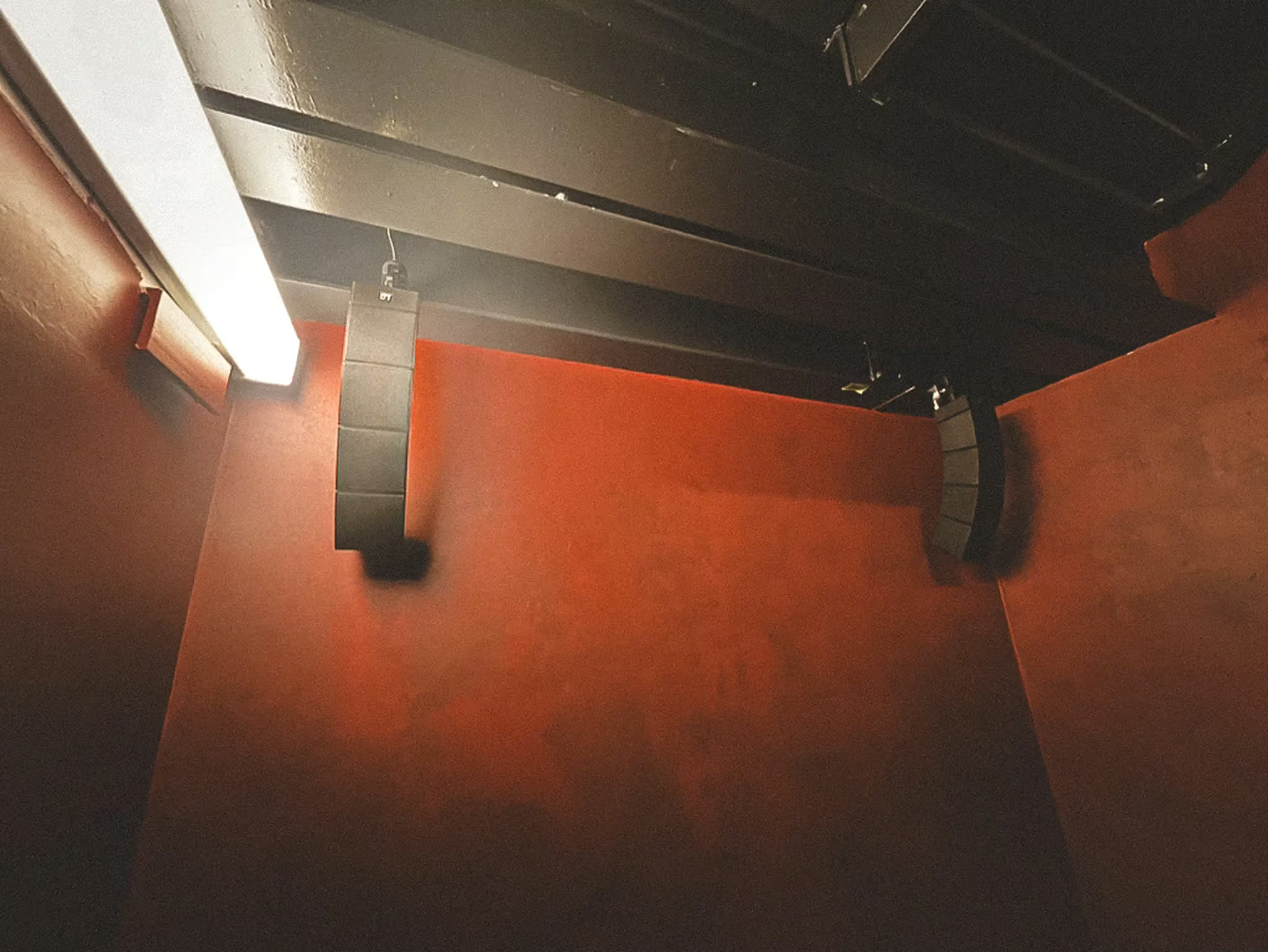
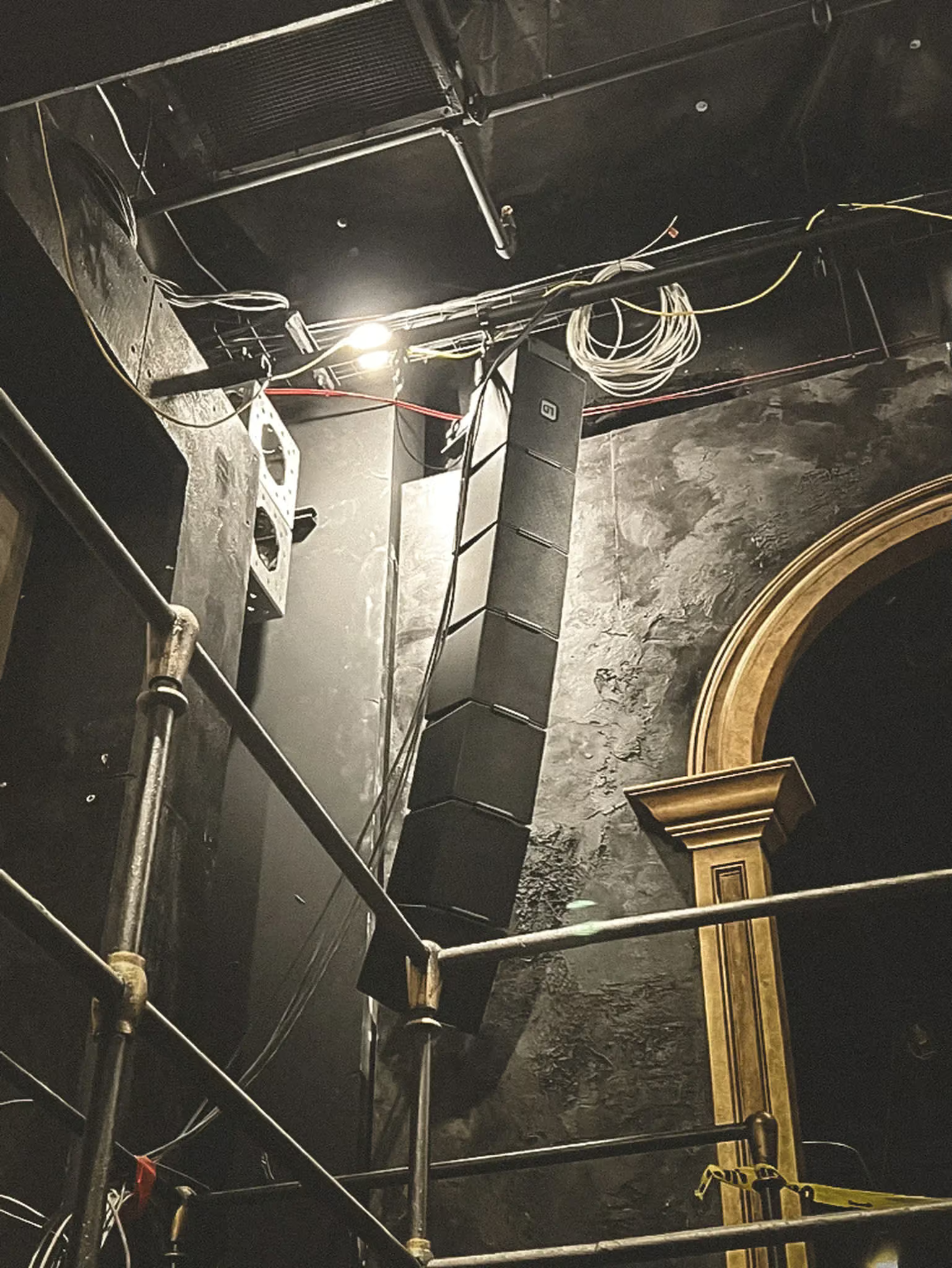
A typical Broadway musical has maybe a dozen speakers — a flown line array on each side of the proscenium, some fills, some monitors. Masquerade has more than a thousand. Hidden in chandeliers, tucked under floorboards, mounted in unistrut, embedded in ceilings, weatherproofed for the rooftop. Brett Jarvis and Lee McCutcheon flew to Germany to audit the LD Systems portfolio in person before signing off on the install.
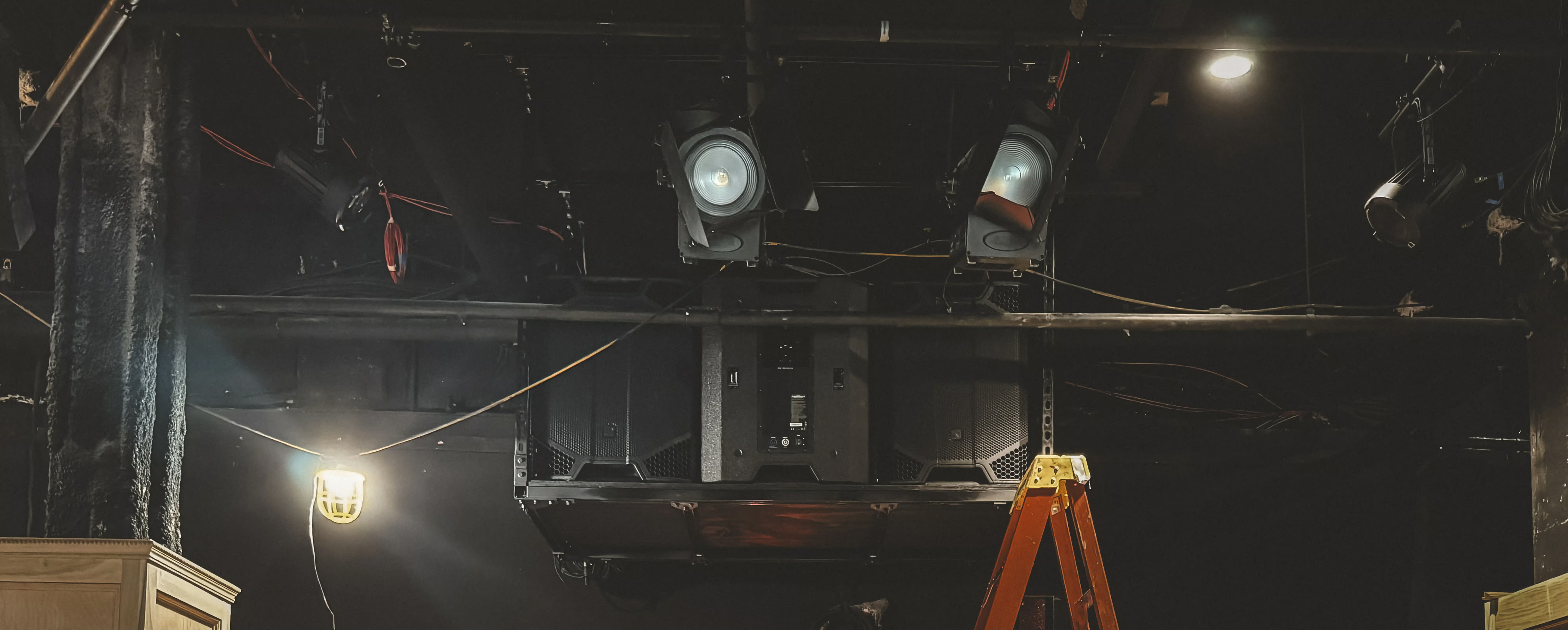
During the fly-tower scene — a fake performance below, a fight on the rigging above — Masquerade simulates both at once with two banks of LD Systems loudspeakers tucked out of view. ~50 fire down through the floorboards (the orchestra below); ~40 fire up toward the ceiling (pulleys, sandbags, ropes overhead).
Source · PAS · Precision Audio Services, Jan 2026
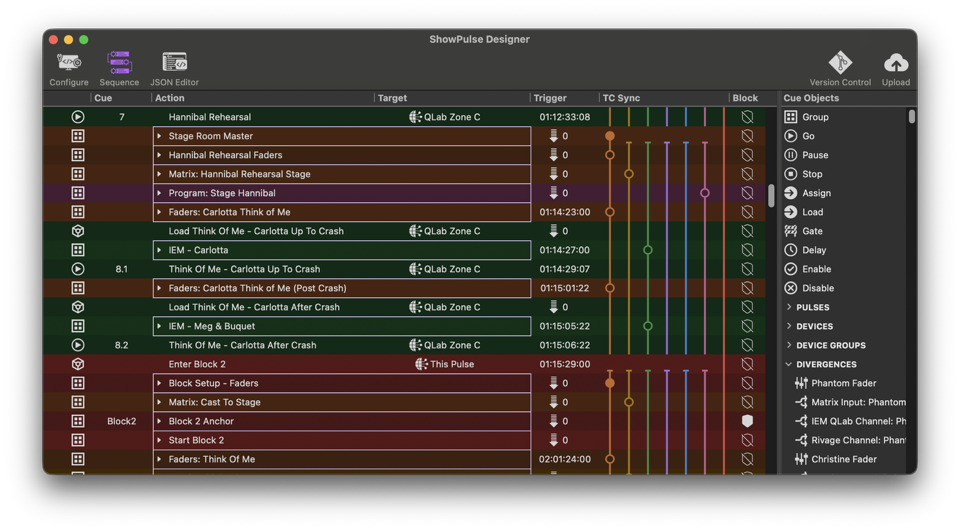
If Masquerade has no conductor and no live mixer, how does every musical entrance land on the right beat in the right room with the right actor? Timecode. One global clock, six pulse-specific clocks, twenty-four geographic zones — thirty-one streams running at once. Plus a ShowPulse feature called Divergences that recalls a different fader / EQ / dynamics / effects chain per actor per role per pulse.
Every other clock derives from this one. One real second = five minutes of show.
"The benefit of a geographic timecode zone is that since a song will occur in some area at least six times, we are able to reuse the same code over and over, making programming more manageable."
— Sean Beach, ShowPulse chief architect · Precision Audio Services, Jan 2026
Every actor's voice is different — vocal range, formant frequencies, sibilance, breath control, where the earset capsule sits relative to the mouth, how their costume couples acoustically to the mic. A mix that flatters one Christine clips the next; a compressor that breathes for one Phantom strangles another.
Traditional Broadway has an A1 riding the faders, adjusting in real time. Masquerade has no live mixer during a performance. So every parameter — fader, EQ shelves, compressor ratio and threshold, de-esser, reverb send, delay tap, pan — has to be programmed in advance for every actor, in every role, in every room.
ShowPulse calls these snapshots Divergences. The six pulses each get their own Phantom and their own Christine; Raoul, Madame Giry and the rest are covered two- and three-deep; the remainder of the ensemble appears in every pulse — twenty-eight performers in all. ShowPulse recalls each one's programmed mix the instant they step to the mark, swapping every parameter mid-performance with no fader move on a board because there is no board.
One snapshot per performer, recalled the moment the operator locks tonight's casting. Multiply by the rooms each pulse visits — roughly fourteen — and you cross five figures of unique mix state.
"I could camp out in a room and mix each cast as they came in, so everyone has their own fader moves, EQ, and dynamics. And then the system plays back that control data, with some tweaks that we add in on a nightly basis."
— Brett Jarvis, Sound Designer & Head of Show Control · Precision Audio Services, Jan 2026
Forty-two wireless channels — twenty-eight actor mics plus fourteen-ish in-ear monitor feeds — running on Sennheiser's brand-new Spectera platform in one of the densest RF environments on Earth. The production turned the upper floors of 218 W. 57th into a Faraday cage to give RF coordinator Cameron Stuckey enough clean spectrum to run. Stuckey went on to coordinate Super Bowl LX months later.
"[Masquerade] required high-density, bidirectional wireless in a complex structure environment, utilizing every feature of Spectera — device capacity, multi-zone operation, modulation diversity. It was the best demonstration of the system's stability."
— Cameron Stuckey, RF Coordinator · Sennheiser, 20 Feb 2026
Cameron Stuckey was the lead RF coordinator for Super Bowl LX, just months after Masquerade.
Ben Stanton's brief was deceptively simple: light at least thirty spaces across four floors and a rooftop, make each room feel like a different play, hide the rigs. His tool of choice was the Ayrton Diablo S — a 300-watt LED profile small enough to disappear into a chandelier crystal and bright enough to flood a ballroom. They were hidden in plaster ceilings, on unistrut runs, in cornice molding, on PRG-built freestanding truss, and inside the chandelier itself.
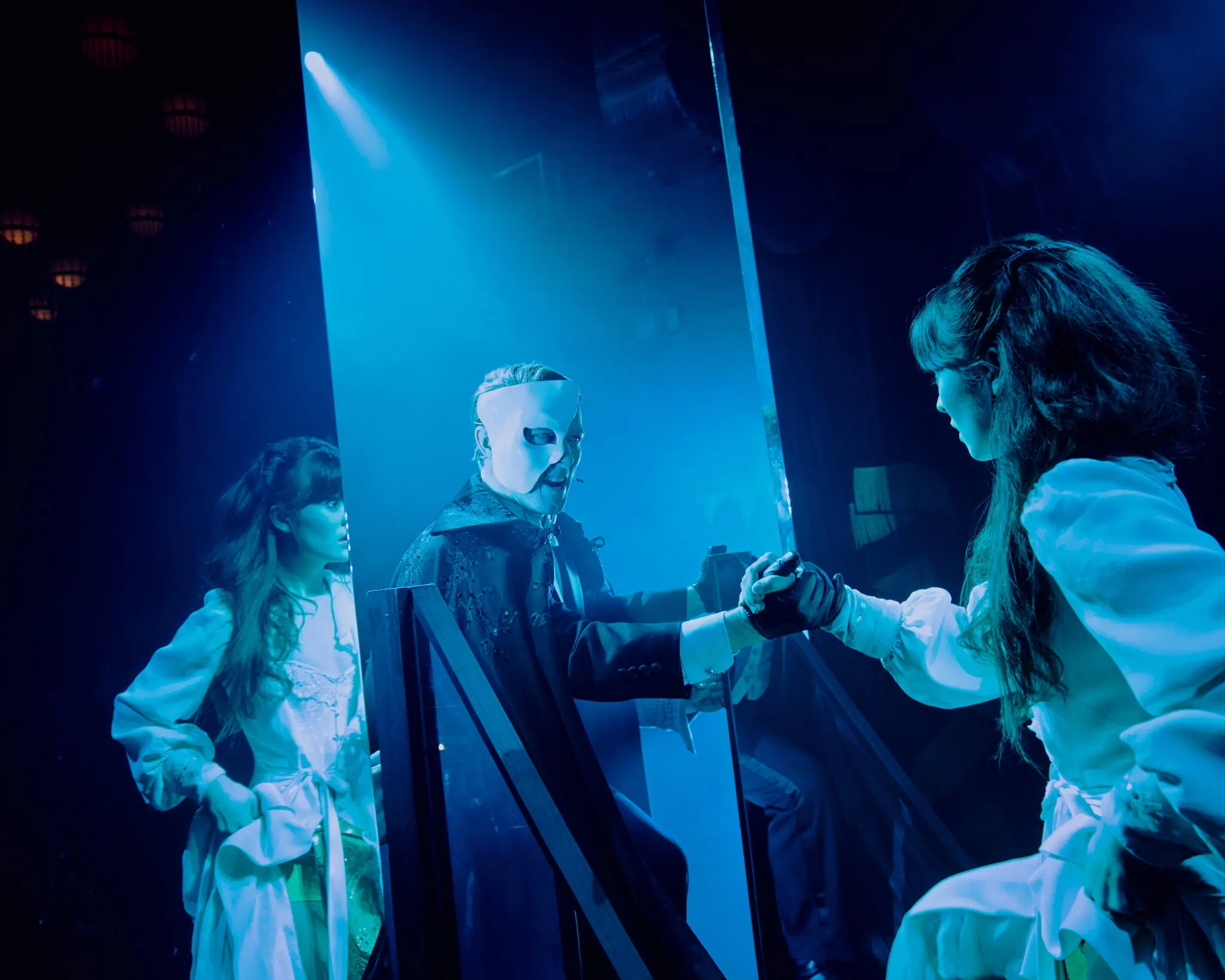
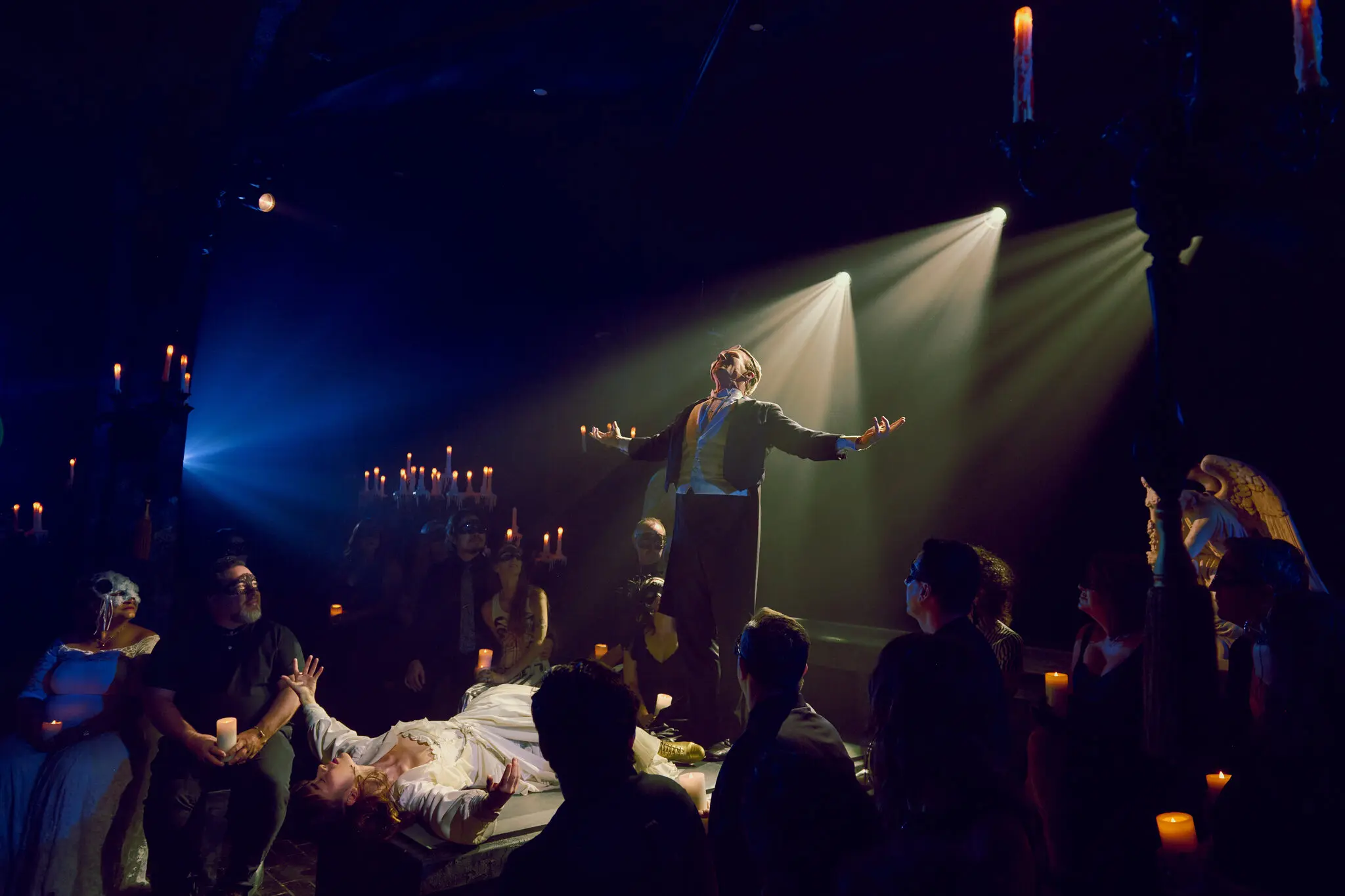
300 W LED Moving Profile · Made in France
"Size and weight were crucial factors, and the Diablo has a high output for their size and are really beautiful lights. They are concentrated in certain spaces, some mounted in the plaster ceilings, some on unistrut and other unconventional rigging solutions."
— Ben Stanton, Lighting Designer · ACT Entertainment, 24 Mar 2026
Production designer James Fluhr named the chandelier after his aunt — the first person to take him to Phantom, and someone who never got to see the original Broadway run. 'Now, in Masquerade, she can glow every night.' Eight hundred pounds. Four concentric rings, the widest 13 feet across at the ceiling tier and tapering down to a 1.5-foot ring at the bottom point. More than 30,000 hand-laid Preciosa crystals. Each ring on its own automated winch. A 6-foot-per-second drop that smoothly transitions into slow motion. LED pixel tape inside the largest ring for flame simulation. Steam.
The pre-show chandelier rises from audience level to its full assembled position at the ceiling. Top ring leads, the rest cascade in as each previous ring crosses its 50 % mark.
The chandelier trembles violently, settles, trembles again, then the bottom two rings drop at 6 ft/sec into slow motion. The largest top ring ignites with LED pixel tape and steam.
"Inside the larger ring are smoke and lighting effects, designed to create the appearance that the chandelier is on fire. Steam is released, and LED pixel tape creates a flickering effect to simulate flames. It was an effective way to re-create the iconic moment from the theatrical production."
— Troy Atkinson, Managing Director, PRG · 27 Feb 2026
The audience walks down through foggy tunnels into the underground lake. A gondola is waiting on a black floor. It glides silently across during Music of the Night — no track, no overhead wire. A strip of magnetic tape adhered to the floor; a laser-eye sensor on the boat's underside reads the strip; magnets along the tape trigger acceleration, deceleration, stops. The same passive logic warehouse robots use. When the director wants to change the path, the crew peels up the tape and re-lays it.
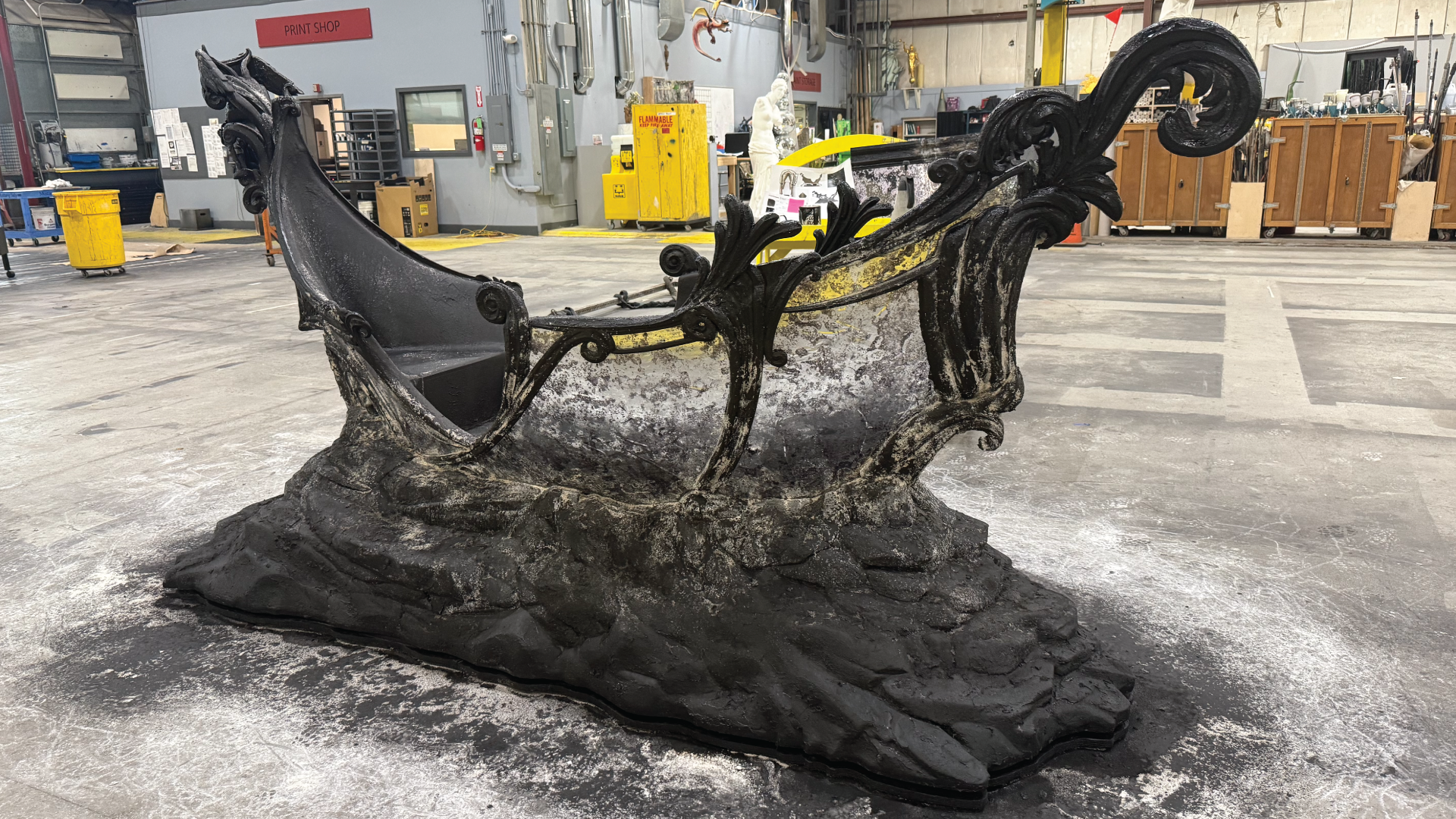
"You can literally adhere the magnetic tape to the floor, and the tracking system's laser eye follows that strip. The advantage of this over a traditional deck track is significant — if adjustments are needed in the boat's movement, you can simply peel up the tape and reattach it."
— Mark Peterson, GM Sales & BD, PRG · 27 Feb 2026
Same passive logic warehouse AGVs (automated guided vehicles) use. Sensor manufacturer not publicly disclosed.
ShowPulse switches automatically between several hundred discreetly mounted IP cameras as each pulse moves through the building. The control-room operator and each floor's stage manager see the right view at the right moment — whichever feed is most useful right now. The chandelier cameras are different: hard-wired, not networked, and latency-free, because automated motion has to be monitored with no delay between what happens in the room and what the operator sees on screen.
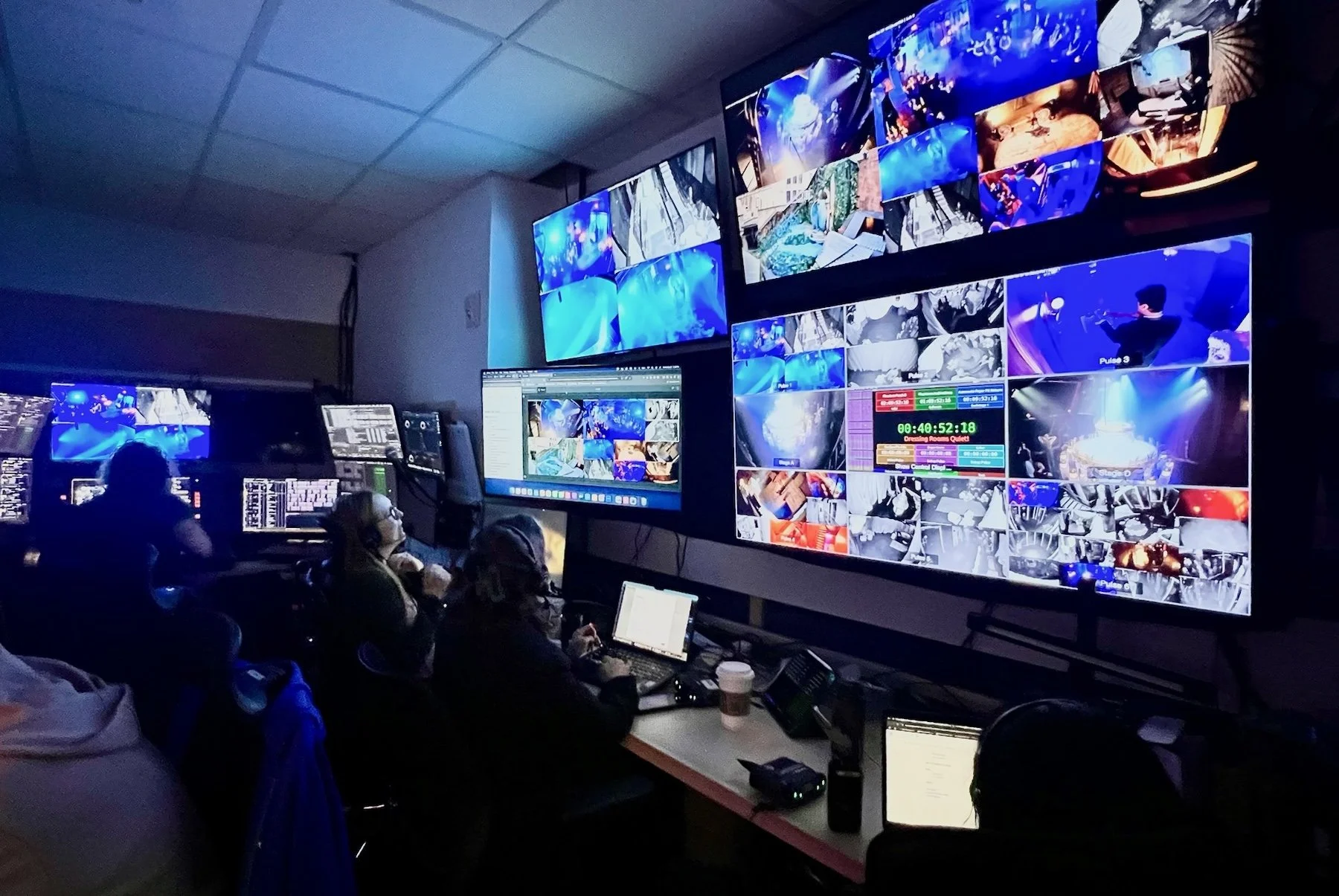
"The cameras pointed at the chandelier are hard-wired and latency free, to ensure the necessary precision in monitoring its motion."
— Brett Jarvis, Sound Designer & Head of Show Control · Precision Audio Services, Jan 2026
Six pulses. Sixty audience each. Fifteen-minute stagger. Three hundred sixty spectators a night, snaking through five floors of a 128-year-old landmark building. The choreography that's not on stage is just as engineered as the show itself. Distributed power centers, one per floor or per part of a floor. A fire-alarm interlock that mutes the entire PA except the emergency-paging paths. HVAC coordinated with show cues because the HVAC equipment is on the roof and so are the songs.
Per performance: 6 pulses · 60 audience each = 360 spectators · 28 live miced actors · 15-minute stagger · each pulse runs 2 hr 5 min
"There were days where we just moved 60 people around the building to understand timings… the final product was coordinated down to the thirtieth of a second."
— Sean Beach · Precision Audio Services, Jan 2026
The last third of the show has two pre-blocked staging plans. Path A is the default — "All I Ask of You" plays outdoors on the rooftop. Path B is the bad-weather alternative — the rooftop sequence routes indoors and the rest of the third act rearranges around it. The same physical rooms appear in both plans, just used for different scenes. Hover (or click to pin) a room badge to see every cell that uses the same room.
Stays in the Carnival Room
Indoor Rooftop is the rain-day backup — same room Path A just used for 'Learn to Be Lonely'
Same room Path A used for 'Young Phantom' — directly next door to the Carnival Room. Early pulses hear the carnival next door while Christine mourns at her father's grave.
Same outdoor graveyard space — re-dressed from the "Wishing" scene a moment earlier
The covered walkway threads the same outdoor graveyard, kept dry for an audience walk in active rain (fan account, Nozomipwr)
Source · fan walkthrough of both path versions during previews. The production was still in previews at the time, so details may have shifted since; corrections welcome at archive@behindthemasquerade.com.
Every piece of equipment, every quote, every figure on this page traces back to a publicly available source. The bibliography is below. Items marked “not publicly disclosed” mean exactly that — the production has not released the information through trade press or press releases as of the page's last update.
Tooltip demo: hover or focus any short key here — PAS, PRG, AH, Senn2, BW — and click to pin it to the footer.